Analysis and Design of Various Types of Isolated Footings
Learn about the Isolated Footing Foundation
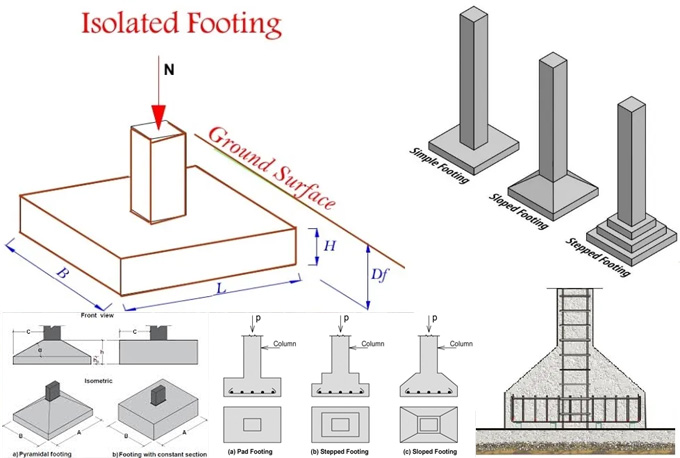
The isolated footing is the foundation structure that has been used to support the individual columns in the building structure. The isolated footing foundation helps to distribute the load of the column to the ground below the structure and thus helps to prevent the structural failure of the building structure. The isolated footing foundation has been commonly used in construction work sites where the soil has good load-bearing capacity, and the columns of the structure are far apart.
The plan of the isolated footing foundation is usually square or rectangular. The isolated footing foundation is one of the simplest and cost-effective footing structures that has been commonly used in construction work. The structural stability of the construction structure has been ensured by using the isolated footing foundation, and the overall construction costs of the building have also been reduced by using this type of foundation structure.
Discuss the different types and shapes of isolated footing foundations
Type
Isolated spread footing or Isolated pad footing
This type of isolated footing foundation has been constructed under each column. The isolated spread footing is typically square, circular or rectangular in shape, which have a uniform thickness. This type of isolated footing helps to reduce the bending moments and shearing forces at the critical sections. In the isolated spread footing, concrete has been added with or without reinforcement, which involves an increase in its ultimate load-bearing capacity.
Isolated stepped footing
This type of isolated footing is also very popular in residential projects. In this type of isolated footing, generally, 3 concrete cross-sections have been stacked upon each other to give it the shape of a step.
Isolated sloped footing
The Isolated sloped footing is also called an isolated trapezoidal footing, which has been designed to maintain an angle of 45 degrees from all sides of that footing. In this type of isolated footing, the requirement of concrete and steel is less, and it is a cost-effective option for the construction work.
Shapes
The shape of the isolated footing foundation has been decided on the basis of the column geometry, the available space at the construction site and the load distribution capability of the footing. The selection of the appropriate shape of the footing helps to achieve uniform soil pressure and also helps to reduce the excessive bending and shear forces. Different types of shapes have been adopted for the isolated footing foundations to suit the practical construction requirements of it. The shape of the isolated footing has been decided to ensure its structural stability under different load conditions. The most common shapes of the isolated footing foundations are square, rectangular or circular.
Understanding the reinforcement detailing of the isolated footing foundation
Creating a concrete cover of reinforcement
In the main reinforcement of the isolated footing, the minimum thickness should not be less than 50mm according to IS 456-200. In the case of the footing in contact with the early surface, there should be a 40mm thickness for the external exposed face, for example, surface levelling PCC. There should be a cover of 75mm if the surface levelling is not used, which helps to cover the uneven surface of the excavation.
Deciding bar diameter
The minimum reinforcement of the isolated footing foundation should not be less than 0.12% of the total cross-sectional area. The minimum diameter for the reinforcement should also not be less than 10mm.
The reinforcement distribution in the isolated footing
In the case of the one-way reinforcement in the isolated footing, the reinforcement has been distributed uniformly throughout the full width of that footing. In the case of the two-way square footings, the reinforcement has been extended in both directions of the footing. In this context, the reinforcement has been distributed uniformly throughout the full width of the isolated footing in the long direction. In the case of the short directions, the reinforcement has been distributed in the central band, and the rest of the reinforcement has been distributed equally on both sides of the ventral band.
Dowel reinforcement process
In the isolated footing foundation, the dowel reinforcement has been used to tie the isolated footing to the above column. The development length of the dowel bars into the columns and isolated footings has been provided along with the development length of the dowel reinforcement.
Deciding lap slice
In the isolated footing, the anchorage of the dowel reinforcement length should be examined to prevent any kind of failure of the dowels in the footing. The appropriate lap slice also helps to prevent the failure of the lap splices between the column bars and the dowels.
Materials used in the construction of the isolated footing foundation
- Cement, sand and aggregates have been used to create a PCC or RCC base.
- Reinforcement bars, including main bars, distribution bars and dowel bars, have been required in the construction of the isolated footings.
- Timber, steel or plywood formwork is required for providing shape to the isolated footing.
- Binding wires and spacers are also required to secure the reinforcement in place.
- Clean water is also required to mix the concrete.
Which factors need to be considered while constructing isolated footing foundations
To ensure a strong and long-term, durable foundation structure, several factors need to be considered, which are as follows:
- A soil test needs to be conducted before the beginning of the construction work, which helps to determine the appropriate size of the footing.
- Correct dimensions and reinforcement also need to be used while designing the isolated footing foundation on the basis of the structural plans.
- The concrete in the isolated footing foundation should be cured for at least 7 to 14 days to achieve full strength.
- While constructing the isolated footing foundation, high-grade cement, aggregates, sand and other construction materials should be used to achieve better durability.
- The construction worker should prevent water accumulation around the footings to avoid weakening or any kind of erosion of the footing structure.